GEEGO Toys
How to choose toys for different age groups starts with one simple question: what can a child safely enjoy right now? Age labels offer a useful first check, but they cannot describe every child’s skills, interests, or pace. A baby may be drawn to a soft crinkle book, while a preschooler may prefer blocks that click together. Small parts, loose buttons, and long cords need special attention around young children. Read the manufacturer’s age guidance and inspect toys for damage before play. Simple habits matter.
This guide explains how toy choices can support changing abilities, from grasping and sensory exploration to pretend play, problem-solving, and coordination. It also considers practical details, such as whether pieces are easy to clean, sturdy enough for regular use, and suitable for the space at home. A costly toy is not automatically a better one. Sometimes a cardboard box holds a child’s attention longer than a busy electronic toy. That can be surprising.
Children develop at different rates, so a birthday alone may not tell you what fits. Watch how a child handles a toy, and adjust when it seems frustrating, unsafe, or too easy. Adult supervision remains important, especially when toys have small components. The best choice is not always obvious. Even careful decisions can miss the mark, and preferences change quickly. The sections ahead offer age-aware guidance while leaving room for each child’s curiosity and family’s judgment.
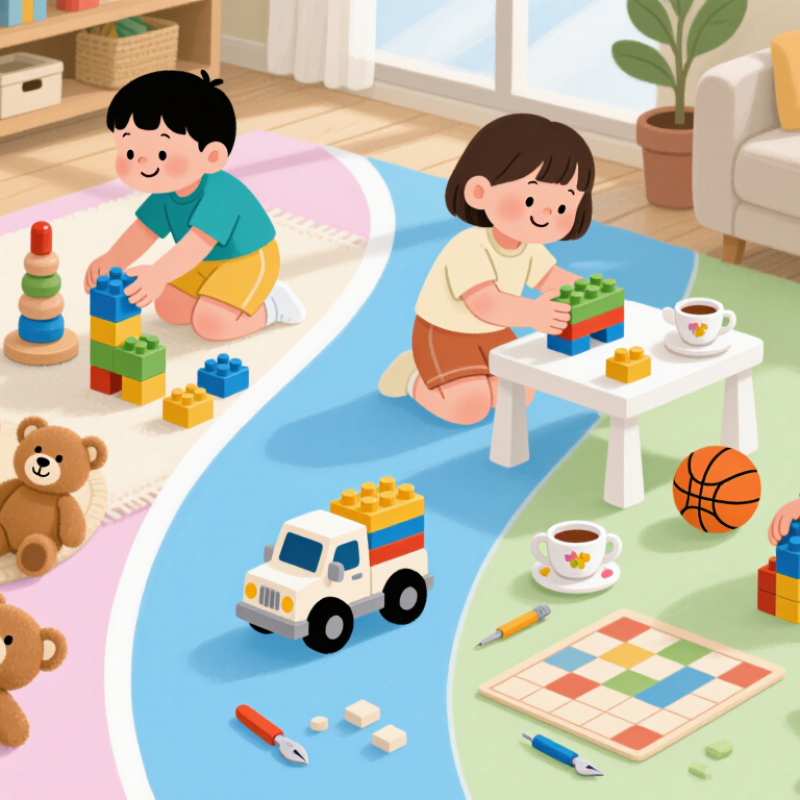
Choosing a toy starts with its age label, but the label is only a starting point. The U.S. Consumer Product Safety Commission estimated 209,500 toy-related emergency-room injuries in 2022, according to its annual toy injury report. That figure covers children and adults; it is not a measure of risk for one child. Still, it makes everyday checks worthwhile. Look for loose parts, sharp edges, cracked plastic, and cords that could wrap around a small neck. For children under three, avoid toys with small parts that could fit in a choking-test cylinder. Small details matter.
Match the toy to the child’s abilities, not just their birthday. A toddler may mouth a bright plastic piece, while an older child may use a toy with fast-moving parts. Check the maker’s age guidance and follow the CPSC’s age-determination guidance, which considers skills and developmental stages. For riding toys, check that the child can reach the controls and use appropriate protective gear. Keep older siblings’ small pieces out of younger children’s play areas. I still find this easy to overlook: a tidy playroom can hide one tiny part under a chair. Recheck toys after rough play, and remove damaged ones. A neat package can still be a poor fit.
The CDC’s developmental milestone checklists describe skills that at least 75% of children can do by a certain age. Use them as a practical guide when choosing toys, not as a deadline for every child. The checklists track development; they do not recommend specific toys or replace professional advice. Keep it simple. For babies, offer safe objects to reach for, hold, and explore during supervised play. For toddlers, cups to stack, large blocks, and containers to fill and empty invite practice with hand movements and problem-solving. Choose items that match your child’s current abilities, with room to try a slightly harder action.
For preschoolers, chunky crayons, simple puzzles, and pretend-play objects can support drawing, problem-solving, and social play. Watch what your child actually does: a puzzle may be too frustrating today, while a few blocks can hold attention for ages. That observation matters more than an age label on a toy. Avoid small parts for children who still mouth objects, and check toys regularly for damage. A milestone not yet observed does not by itself mean something is wrong; children develop at different rates. If you have concerns, bring specific examples to your child’s healthcare professional and ask how to interpret the checklist.
Use CDC milestones as age-based play guides. Each milestone shown is a skill that at least 75% of children can do by the listed age.
Play ideas: For 12 months, try a soft ball or simple push toy; at 18 months, offer sturdy push-and-pull toys; at 2 years, use picture books and pretend-play props; at 3 years, try toys for shared play; at 4 years, offer dress-up items and pretend-play sets; and at 5 years, explore counting games and blocks. These are general ideas—not CDC recommendations. Choose safe toys suited to each child’s interests and abilities. Milestones are examples, not a developmental screening test.
For babies aged 0–12 months, choose toys that encourage looking, reaching, grasping, and interaction with a caregiver. The American Academy of Pediatrics (AAP) advises avoiding screen media before 18 months, except video chatting with an adult. Infants learn through responsive, real-world exchanges, not passive viewing. Keep it simple. A soft cloth book, lightweight rattle, textured teether, or securely mounted mirror can make floor time engaging. Talk, smile, and pause so your baby can respond with a gaze, sound, or little kick.
Screen exposure is common, even among very young children. The Common Sense Census: Media Use by Kids Zero to Eight (2020) reported an average of 49 minutes of daily screen media use among children under two. This is a broad age group, not an infant-only estimate. The World Health Organization’s 2019 guidelines recommend no sedentary screen time for infants under one. It is tempting to think a brighter toy is automatically better; often, a quiet object and an attentive adult offer more useful play.
Check age labels and inspect toys for loose parts, long cords, and accessible batteries. Choose washable items that are easy for small hands to hold, and supervise play, especially during tummy time. A toy can look harmless and still need a closer check.
For toddlers aged one to three, small parts deserve careful attention. In the United States, CPSC rules prohibit small parts in toys intended for children under three when they pose choking, aspiration, or ingestion hazards. A part may look too large to worry about, yet still fit the small-parts test fixture. Check the age label, but do not rely on it alone. A loose wheel, button, or plastic cap can become a hazard after rough play. Small pieces matter.
Choose sturdy toys with parts that cannot easily detach, and inspect seams, wheels, and fasteners before play. Watch for cracks or parts that loosen over time. Keep toys with tiny accessories away from toddlers, especially when older siblings are playing nearby. That is easy to miss. If a piece breaks off, remove the toy until it is safely repaired or discarded. Even careful checks are not perfect, so supervise play and revisit the toy as it wears.
| Age group | Development and play focus | Suitable toy examples | Key selection and safety checks |
|---|---|---|---|
| 1–2 years | Practising grasping, stacking, pushing, pulling, and simple cause-and-effect play. | Large one-piece blocks, sturdy push toys, nesting cups, and chunky shape sorters with pieces too large to present a choking hazard. | Choose toys labelled for the child’s age. For toys intended for children under 3, avoid small parts; check that pieces cannot break off during normal use. Inspect regularly for damage. |
| 2–3 years | Building coordination, language, imitation, and early pretend play. | Large-piece puzzles, chunky crayons, simple pretend-play items, and durable construction toys without detachable small components. | Keep toys with small parts away from children under 3, including toys belonging to older siblings. Supervise play and follow the age grading and safety instructions on the packaging. |
| 3–5 years | Developing imaginative play, problem-solving, and more precise hand movements. | Age-appropriate puzzles, simple building sets, and art materials intended for preschoolers. | Some toys for this age may contain small parts. In the United States, certain toys intended for children at least 3 but under 6 that contain small parts must carry a choking-hazard warning. Keep them out of reach of children under 3. |
| 6 years and older | Practising more complex construction, strategy, creativity, and independent play. | More detailed building sets, board games, and craft kits rated for the child’s age and abilities. | Check age recommendations, instructions, and any small-parts warnings. Store pieces securely when younger children are present. |
U.S. safety note: CPSC regulations generally prohibit small parts in toys and other articles intended for children under 3, subject to specified regulatory exceptions. A warning label does not make a product with prohibited small parts suitable for children under 3. Always check the product’s age grading and applicable safety information.
How to Choose Toys for Different Age Groups?
Match Toys for Ages 3–12 to ASTM F963-23, Mandatory Since April 2024
For toys sold in the United States, ASTM F963-23 became part of the mandatory federal toy safety standard on April 20, 2024. It sets safety requirements for issues such as mechanical hazards, materials, and labeling. Age labels matter, but they are not a substitute for checking how a child actually plays. A curious three-year-old may still put pieces in their mouth.
For ages 3–5, choose sturdy toys with pieces too large to swallow, and inspect seams for cracks. Ages 6–8 often enjoy building sets and simple experiments; check for secure parts and clear instructions. Children 9–12 may prefer detailed kits or strategy games. Match complexity to their patience and skills, not just the age printed on the box. No toy is risk-free.
Tips: Read the age grade and warnings before buying. Check that the product is intended for the child’s age, and look for signs of damage after play. For gifts, ask caregivers about sensitivities or younger siblings at home. ASTM compliance is an important baseline, but supervision and sensible storage still matter. Labels can be easy to overlook, especially when a toy is wrapped.
Check for loose parts, sharp edges, cracked plastic, and long cords. Small details matter.
An estimated 209,500 toy-related emergency visits involved children and adults. It does not measure one child’s personal risk.
Use the age label as a starting point. Match the toy to your child’s abilities and supervise play.
Avoid small parts that could fit inside a choking-test cylinder. Keep older siblings’ tiny pieces out of reach.
Checklists describe skills achieved by at least 75% of children at a certain age. They are guides, not deadlines.
Try a soft cloth book, lightweight rattle, textured teether, or securely mounted mirror. Talk and pause for your baby’s response.
Guidance advises avoiding screen media before 18 months, except video chatting with an adult. Real interaction matters.
Watch how your child responds. A few blocks may work better today; I sometimes overlook that. A tidy room can fool me.
How to choose toys for different age groups begins with safety, not just entertainment. The CPSC estimated that toy-related injuries led to 209,500 emergency room visits in 2022, so caregivers should check age labels, inspect toys for damage, and consider choking, sharp-edge, and strangulation hazards. Developmental milestones can also guide choices: CDC checklists describe skills achieved by at least 75% of children at each age, offering a useful reference while recognizing that children develop at different rates.
For infants from birth to 12 months, choose sturdy, easy-to-clean toys that encourage looking, reaching, and grasping, and follow guidance to avoid screens before 18 months. For toddlers aged 1 to 3, select simple, durable toys without small parts, which are prohibited in toys intended for children under three. For ages 3 to 12, match toys to a child’s abilities and interests, and look for products that meet ASTM F963-23, a toy safety standard made mandatory in April 2024.
