 GEEGO Toys
GEEGO Toys
GEEGO Toys
Puzzle play is more than a quiet activity on a coffee table. A 500-piece landscape puzzle can train patience, visual attention, and flexible problem-solving. For children, a wooden shape puzzle may strengthen hand control while encouraging language such as “turn,” “match,” and “try again.” For adults, crosswords, jigsaws, and logic puzzles can create a focused break from constant digital interruptions. But what are the benefits of puzzle play, and how strong is the evidence behind popular claims?
The American Academy of Pediatrics identifies play as important for cognitive, physical, social, and emotional development in its clinical report, The Power of Play (2018). UNICEF and the LEGO Foundation also describe playful learning as a way to build problem-solving, communication, and self-regulation skills in Learning through Play (2018). These authoritative sources support the value of meaningful play, although they do not prove that every puzzle improves memory or prevents cognitive decline. That distinction matters.
Research on adults remains promising but uneven. Some studies associate mentally stimulating activities with better cognitive engagement, yet puzzle play should not replace sleep, exercise, social connection, or professional care. The World Health Organization’s physical activity guidelines also remind us that seated activities need balance. This guide examines ten practical benefits across ages, from concentration and spatial reasoning to emotional calm and family connection. Results can vary. A puzzle may frustrate one child and comfort another. That is part of the learning, too. Expect progress, not perfection.
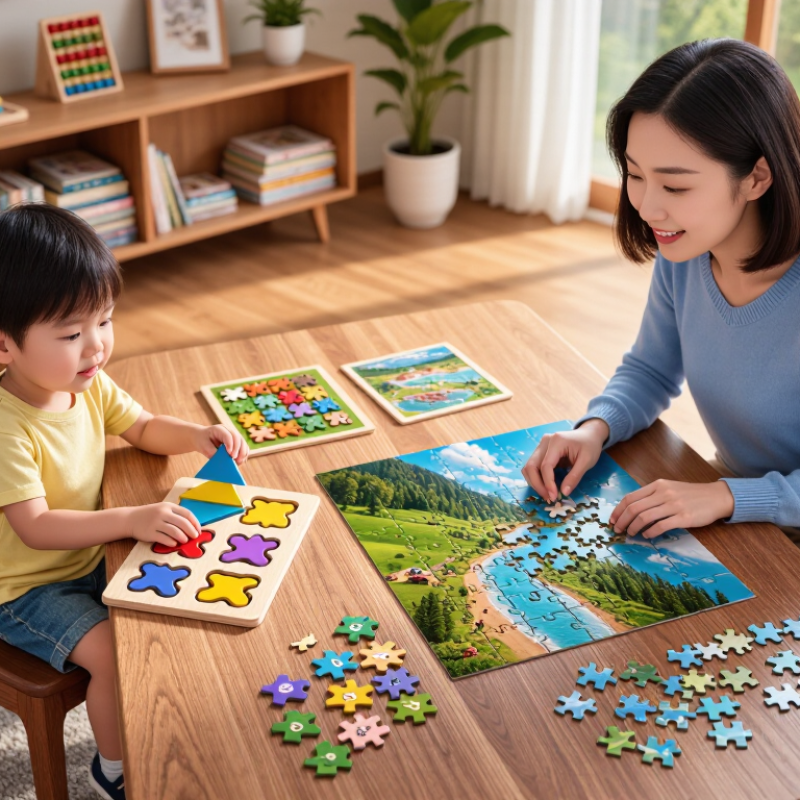
Puzzle play is the active process of solving, arranging, or completing a challenge with clear pieces and rules. A child may turn cardboard shapes, match colors, or fit wooden blocks together. An adult may study a crossword, logic grid, or three-dimensional model. Each move asks the mind to notice patterns, hold information, and test possibilities. The hands stay busy, but the brain leads.
This activity can strengthen attention, visual-spatial reasoning, working memory, planning, patience, and fine motor control. It may also support language when players describe shapes, clues, or strategies. Shared puzzles encourage communication and cooperation. Quiet puzzle time can reduce daily tension, although it should not be treated as medical care. I often notice a small lift in confidence after solving one difficult section. That feeling matters.
Puzzle play also teaches useful error habits. A wrong piece is feedback, not failure. Children learn to adjust their approach, while adults practice flexible thinking during demanding tasks. Some puzzles require several attempts. That can feel frustrating. It can also reveal how quickly we rush. Progress is rarely dramatic; one corner may take ten minutes. For reliable benefits, choose challenges that are neither effortless nor overwhelming, and allow breaks when attention fades. Age, interest, vision, motor ability, and puzzle design all affect the experience. Not every puzzle suits every mind.
| No. | Potential Benefit | How Puzzle Play Engages the Mind | Skills Involved | Practical Example | Suitable Adaptation |
|---|---|---|---|---|---|
| 1 | Improves visual-spatial reasoning | Players compare shapes, positions, colors, and orientations to determine how pieces or patterns fit together. | Mental rotation, spatial awareness, visual discrimination | Assembling a jigsaw puzzle or solving a tangram design | Use large, high-contrast pieces for young children or older adults. |
| 2 | Strengthens problem-solving | The player identifies a goal, tests possible solutions, notices errors, and changes strategy when needed. | Reasoning, planning, flexible thinking | Finding the correct path in a maze or completing a logic grid | Begin with simple rules and gradually increase the number of conditions. |
| 3 | Builds attention and concentration | Puzzle play requires sustained attention to details while filtering out irrelevant information. | Selective attention, sustained attention, visual scanning | Searching for a missing piece or identifying differences between images | Choose short activities first, then extend play time as comfort improves. |
| 4 | Supports memory practice | Players remember visual details, rules, locations, patterns, and strategies while working toward a solution. | Working memory, visual memory, recall | Completing a matching game or recalling where particular pieces belong | Use familiar themes for children and progressively more complex patterns for adults. |
| 5 | Encourages patience and persistence | A puzzle often requires repeated attempts, delayed rewards, and tolerance for mistakes before completion. | Self-regulation, perseverance, frustration tolerance | Trying several piece combinations after an initial attempt fails | Offer encouragement and manageable challenges rather than rushing to provide answers. |
| 6 | Develops early mathematics skills | Counting, sorting, sequencing, comparing, and recognizing shapes provide informal mathematical practice. | Numeracy, classification, pattern recognition | Sorting pieces by color or completing a number sequence | Use shape sorters and simple number puzzles for preschool learners. |
| 7 | Expands language and literacy skills | Word puzzles encourage vocabulary, spelling, letter recognition, and discussion of meanings and clues. | Vocabulary, spelling, reading fluency, verbal reasoning | Solving a crossword, word search, or age-appropriate anagram | Adjust word length and provide picture clues for beginning readers. |
| 8 | Promotes creativity | Open-ended puzzles allow players to explore multiple arrangements, interpretations, and solution paths. | Ideation, experimentation, divergent thinking | Creating different pictures with construction pieces or inventing a pattern | Use puzzles with more than one possible arrangement or outcome. |
| 9 | Supports social interaction | Collaborative puzzles require communication, turn-taking, shared planning, and negotiation of ideas. | Cooperation, communication, perspective-taking | Working with family members or classmates to complete a shared puzzle | Set a common goal and invite each participant to explain their reasoning. |
| 10 | Provides a relaxing screen-free activity | Focused, hands-on play can create a calm routine and give the mind a structured alternative to passive screen use. | Mindful attention, emotional regulation, sensory engagement | Completing a puzzle during a quiet evening or shared family activity | Choose comfortable lighting, an appropriate difficulty level, and a distraction-free space. |
Puzzle play involves solving, arranging, or completing challenges with clear pieces and rules. Children may match colors or fit wooden shapes together. Adults may solve word, logic, or three-dimensional puzzles.
Puzzles can support attention, working memory, planning, and visual-spatial reasoning. They also encourage flexible thinking. The brain tests possibilities while the hands handle pieces.
Yes. A wrong piece provides useful feedback instead of proving failure. Children can rotate the piece, test another space, and change strategies. That lesson matters.
Adults may strengthen concentration and mental switching through challenging puzzles. A logic grid can create a quiet space away from constant notifications. However, puzzle practice will not improve every skill automatically.
Focused puzzle time may reduce mental clutter and support calmer breathing. A child might sort blue pieces beside a glass of water. An adult may feel a small lift after completing one difficult section. Sometimes, it simply does not help.
No puzzle suits every person. Age, interest, vision, motor ability, and puzzle design all affect the experience. Timed tasks may increase pressure for some players. I might mistake quietness for calm.
Choose a challenge that is neither effortless nor overwhelming. Match it with the player’s energy and skill. Use soft lighting and limit nearby distractions. Stop before tiredness becomes irritation.
Family members can work quietly together and discuss shapes, clues, or strategies. Adults should praise effort rather than speed. Children need freedom to change methods. Leaving one piece unfinished is acceptable.
No. Puzzle activities may support relaxation, but they are not medical treatment. Ongoing distress needs appropriate professional support. Puzzles are helpful tools, not complete solutions.
Puzzle play is a simple yet powerful way to engage the mind through observation, memory, logic, and hands-on problem-solving. What are the benefits of puzzle play? For children, puzzles can support early learning, concentration, spatial awareness, language development, and confidence as they work toward completing a challenge. For adults, they may help maintain mental flexibility, encourage creative thinking, and provide an enjoyable way to stay mentally active.
Beyond cognitive growth, puzzle activities can promote patience, focus, relaxation, and emotional satisfaction. Working on puzzles with family, classmates, or friends also encourages communication, cooperation, and shared problem-solving. In educational settings, puzzles can make learning more interactive by connecting abstract ideas with practical challenges. The best puzzle depends on a person’s age, interests, skill level, and goals, whether those goals involve learning, social connection, stress relief, or personal achievement.
