China Top 10 STEM Toy Manufacturers Why Are They Popular?

Time:2026-09-23 Author:Sienna
0%

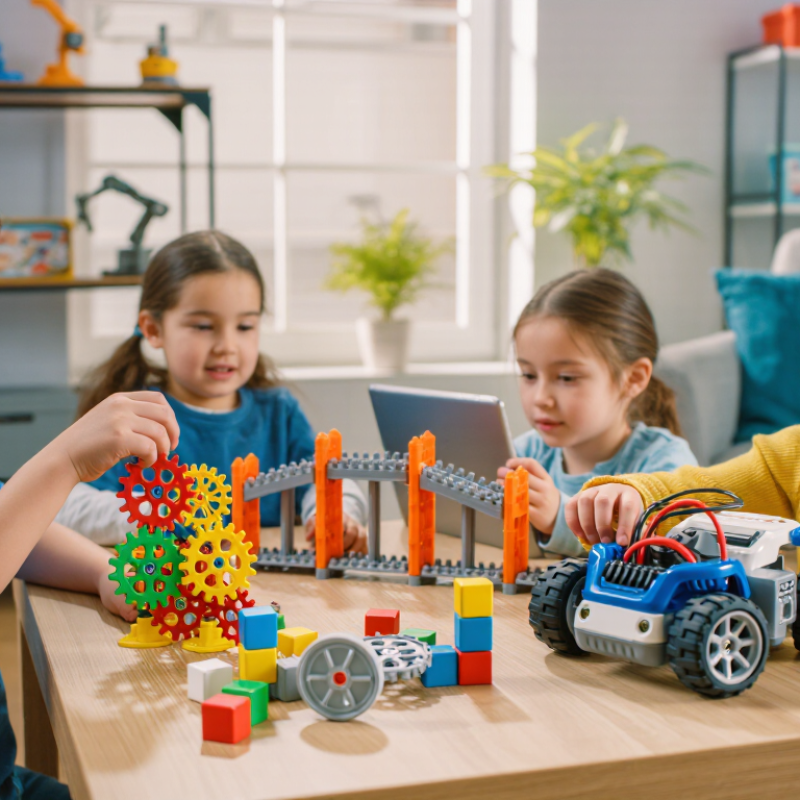
Why are STEM toys popular for kids? The answer is visible in many homes: a child connects gears, tests a small bridge, or programs a robot beside a tablet. These toys turn abstract ideas into touchable results. A failed wheel, a loose circuit, or a collapsing tower becomes immediate feedback. That practical experience explains why parents and educators increasingly value play-based science and engineering.

Market evidence supports this shift, although popularity does not automatically prove educational quality. Grand View Research’s STEM toys market analysis identifies growing demand for coding kits, robotics, construction sets, and experiment-based products. Its reports also forecast continued global expansion through the decade, driven by digital learning and parental interest in future skills. Circana’s 2023 U.S. toy industry report recorded approximately $28.6 billion in total sales, showing the scale of the wider sector. STEM toys represent only one segment, but their connection with technology makes them especially visible.

Mitch Resnick, Professor of Learning Research at the MIT Media Lab, offers an important caution: “The goal is not to get kids to think like computers. The goal is to get them to think like people.” His view helps explain the appeal of leading Chinese manufacturers. Companies such as DJI, Makeblock, ELECFREAKS, and others combine robotics, coding, mechanics, and colorful, reusable components. Their products often provide clear instructions, yet invite children to change the design. That balance matters. Some kits may promise too much, and a busy box cannot replace patient adult guidance. Still, China’s top STEM toy manufacturers are popular because they make complex ideas feel buildable, testable, and surprisingly personal.
China Top 10 STEM Toy Manufacturers Why Are They Popular?

What Defines a Leading STEM Toy Manufacturer in China

A leading STEM toy manufacturer in China is defined by more than production capacity. It combines engineering knowledge, child-focused design, and disciplined quality control. Experienced teams test whether a circuit kit survives repeated assembly, not just whether it works once. They examine loose wires, small components, sharp edges, and battery compartments before shipment. Simple details matter.

Reliable manufacturers also connect design with classroom experience. Their engineers may work with educators to improve instructions, learning goals, and age suitability. A strong product encourages children to predict, build, test, and adjust. Clear diagrams and well-organized parts reduce frustration. However, not every prototype succeeds. Some activities become too difficult, while others feel attractive but teach very little. Honest testing helps reveal these weaknesses.

Professional factories maintain traceable materials, documented inspections, and consistent supplier controls. They check dimensions, electrical performance, packaging strength, and relevant safety requirements. Independent testing can add credibility, especially for products sold across different markets. Communication is equally important. Buyers need accurate timelines, sample feedback, and clear correction plans. A manufacturer that admits a design flaw can be more trustworthy than one that promises perfection. Production speed matters, but dependable learning value matters more.

China’s Top 10 STEM Toy Manufacturers by Product Strength

China’s leading ten STEM toy manufacturers are best compared by product strength, not factory scale alone.

Grand View Research estimates the global STEM toys market will grow at about 8% annually through 2030. This demand favors products that make children build, test, and revise ideas with their hands.

The strongest Chinese manufacturers usually combine modular construction, clear instructions, and durable materials. Their robotics kits often use replaceable parts, simple coding interfaces, and progressive difficulty.

Science sets may include measurement tools, magnets, gears, or safe circuit components. The China Toy Association reported that China remains a major global toy production and export center, supported by mature supply chains and rapid product iteration.

That manufacturing depth helps companies control tooling, packaging, and small-batch testing.

Product strength still needs closer examination.

Some kits look impressive but offer limited experiments after assembly. That weakness is easy to miss. Independent safety testing, age-appropriate design, and compliance documentation should guide procurement decisions.

TÜV Rheinland and other testing organizations emphasize mechanical, chemical, and electrical safety in children’s products. Leading manufacturers increasingly add multilingual manuals, teacher guides, and digital learning support.

Yet digital features can become unnecessary distractions. The better products keep the core experience tangible: a child turns a wheel, measures a result, and changes the design after failure.

Details count.

Key STEM Toy Categories and Learning Technologies They Offer

China’s leading STEM toy manufacturers offer diverse categories built around practical learning. Robotics kits let children assemble motors, gears, and sensors, then test movement on a living-room floor. Coding toys often use block-based programming, making sequences easier to understand before children write text code. Circuit kits introduce switches, lights, sound, and basic electricity through visible cause-and-effect activities.

Engineering sets focus on bridges, vehicles, hydraulic arms, and mechanical structures. Many products now connect with tablets through guided lessons, progress tracking, and interactive simulations. Some include augmented reality overlays that label components or show hidden mechanisms. These tools can improve engagement, but they should support hands-on work rather than replace it. Screens cannot fully explain why a loose gear slips.

Manufacturers also increasingly use modular parts, reusable components, and adjustable difficulty levels. This design helps one kit serve different ages and learning stages. In practical testing, clear instructions, durable connectors, and safe battery compartments matter as much as advanced software. A complicated app may impress adults but frustrate younger learners. Some learning claims still need stronger independent evidence. Parents and educators should check testing information, age guidance, material quality, and privacy settings before purchase. The best STEM toys leave room for mistakes, redesign, and questions without forcing one correct result.

Why Chinese STEM Toy Manufacturers Are Popular Worldwide

Chinese STEM toy manufacturers have become popular worldwide because they combine engineering skills with practical production speed. In supplier evaluations, buyers often see complete workflows: concept sketches, 3D-printed samples, mold testing, assembly, and packaging under one roof. This reduces delays and makes product changes easier. A robotics kit may move from a classroom idea to a tested pilot run within weeks. That matters to schools, distributors, and online educators.

Their advantage is not only lower pricing. Many factories source electronic parts, plastics, magnets, and sensors through established regional networks. Engineers can adjust gear ratios, battery compartments, or instruction steps for different age groups. Export teams also understand documentation, multilingual packaging, and toy-safety requirements in major markets. Reliable manufacturers provide material records, test reports, and sample approvals before mass production. Still, paperwork can vary in quality. Buyers should verify certificates directly and inspect production batches.

Worldwide demand also grows because Chinese suppliers accept customization. A learning kit can use local examples, such as bridges, wind turbines, or simple coding challenges. Small trial orders help educators test whether children understand the activity, not merely enjoy colorful parts. That distinction is important. Some designs remain too complex, while low prices can hide weak instructions or inconsistent components. Continuous feedback, independent testing, and honest factory communication create stronger products over time. Mistakes still happen.

How to Select the Right Chinese STEM Toy Manufacturer

China Top 10 STEM Toy Manufacturers: Why Are They Popular?

How to Select the Right Chinese STEM Toy Manufacturer

China’s STEM toy sector combines engineering talent, flexible tooling, and mature export logistics. Circana’s 2023 global toy review reported a 7% sales decline, making cost control and product differentiation more important. Do not choose a supplier from a catalog alone. Request a working sample, bill of materials, safety test records, and production photos. Watch the details. Are wires insulated? Do gears turn smoothly? Can a child remove small parts easily?

I recommend checking the manufacturer’s experience with your destination market. Ask for test reports from ISO/IEC 17025-accredited laboratories. Confirm relevant requirements, such as EN 71, ASTM F963, CPSIA, or REACH. Requirements differ by market. A factory should explain this clearly, not simply promise “full compliance.” Review quality procedures for incoming materials, first-article inspection, and final sampling. ISO 9001 certification can support reliability, but it does not replace product testing.

Visit the production site when possible. Check injection-molding rooms, assembly benches, packaging lines, and batch records. I once trusted a polished prototype too quickly; the second sample exposed loose connectors and unclear instructions. That mistake was expensive. Ask about minimum order quantities, mold ownership, spare parts, and defect handling. The strongest partner offers transparent communication and realistic delivery dates, even when the answer is inconvenient. Fancy samples can mislead.

China Top 10 STEM Toy Manufacturers Why Are They Popular? - How to Select the Right Chinese STEM Toy Manufacturer

A practical, brand-neutral evaluation framework for comparing Chinese STEM toy manufacturing partners.

No. Evaluation Dimension Why Chinese STEM Toy Suppliers Are Often Considered Competitive Objective Data or Standard to Check Recommended Weight Evidence to Request Before Selection
1 Product Safety Compliance Established export-oriented factories commonly support testing for major destination markets. Applicable requirements may include EN 71 for the European Union, ASTM F963 and CPSIA requirements for the United States, and ISO 8124 for international toy safety. 20% Recent third-party laboratory reports, test samples, material declarations, and confirmation that reports match the final product and target market.
2 STEM Learning Quality China has a large engineering and educational-product supply base capable of combining electronics, mechanics, coding, and experimentation. Check whether each activity has defined learning objectives, age suitability, instructions, repeatable results, and measurable problem-solving outcomes. 15% Lesson plan, activity map, prototype demonstration, user-testing feedback, and documentation linking each activity to a STEM concept.
3 Engineering and Customization Capability Many Chinese manufacturers provide integrated design, tooling, electronics assembly, packaging, and production services. Evaluate capability in mechanical design, PCB or electronic integration, firmware, app compatibility, mold development, and design-for-manufacturing. 12% Technical drawings, bill of materials, engineering-change process, prototype history, and ownership terms for custom tooling and designs.
4 Quality Management System Factories serving international customers often use documented incoming, in-process, and final inspection procedures. Look for a documented quality system, traceability, defect classification, corrective-action records, and inspection sampling based on an agreed AQL plan. 12% Factory audit report, inspection checklist, sample quality records, calibration records, and corrective-action examples with sensitive information removed.
5 Materials and Component Control A broad domestic manufacturing ecosystem can support plastics, wood, metal parts, sensors, motors, batteries, and electronic components. Verify material specifications, restricted-substance controls, battery safety, component consistency, and supplier traceability. 10% Bill of materials, supplier list, material certificates, safety data sheets where relevant, and documented approval for component substitutions.
6 Production Capacity and Scalability Large and specialized manufacturing clusters can support pilot production and later volume expansion within one supply network. Assess available production lines, monthly capacity for the specific product, peak-season planning, critical equipment, and subcontractor dependence. 8% Capacity statement, production schedule, equipment list, staffing plan, and records showing delivery performance for comparable products.
7 Minimum Order Quantity and Cost Structure A mature supplier base can offer different manufacturing models, from stock components and assembly to fully customized production. Compare unit price, tooling, testing, packaging, engineering, freight assumptions, payment terms, and minimum order quantity separately. 8% Itemized quotation, cost-validity period, tooling ownership terms, sample charges, payment schedule, and a total landed-cost estimate.
8 Lead Time and Supply-Chain Reliability China's concentrated supplier networks can simplify sourcing of multiple components, although lead times still depend on materials and production schedules. Measure sample lead time, tooling lead time, production lead time, on-time delivery rate, and contingency planning for component shortages. 6% Written production schedule, historical delivery record, critical-component lead times, buffer policy, and escalation contacts.
9 Packaging, Documentation, and Export Support Export-focused factories are familiar with multilingual packaging, carton markings, shipping documents, and retailer requirements. Check packaging drop protection, barcode and label accuracy, instruction quality, carton specifications, export documentation, and product traceability. 4% Packaging mock-up, multilingual manual, carton-drop test record, barcode proof, packing list, commercial invoice, and shipping marks.
10 Communication, Transparency, and After-Sales Support Manufacturers competing in international markets often provide dedicated project coordination and remote sample-review processes. Assess response time, English documentation, change-control discipline, warranty policy, spare-parts availability, and complaint-resolution performance. 5% Named project contacts, communication schedule, service-level expectations, warranty terms, spare-parts plan, and written dispute-resolution process.
Total Recommended Evaluation Weight 100% Use the same criteria and evidence requirements for every shortlisted supplier.

Selection note: Certificates and test reports should be verified for authenticity, validity, product identity, destination market, and the exact production version. A factory audit and an independent pre-shipment inspection are recommended before commercial shipment.

FAQS

What types of STEM toys are commonly offered by Chinese manufacturers?

Common categories include robotics kits, coding toys, circuit sets, and engineering models. Children can build motors, bridges, vehicles, and simple hydraulic arms.

How do robotics kits support practical learning?

Children assemble gears, motors, and sensors. They can test movement on a living-room floor. Loose gears may slip, creating useful troubleshooting moments.

Are coding toys suitable for beginners?

Many use block-based programming. Children arrange visual commands before writing text code. The system feels simple, but some apps can still confuse younger learners.

What do circuit kits usually teach?

Circuit kits show switches, lights, sound, and basic electricity. Children see cause and effect directly. Safe battery compartments remain essential.

Can tablets and augmented reality improve STEM learning?

Guided lessons, simulations, and component labels may increase engagement. Screens should support hands-on building. They cannot fully explain a loose connection.

What should buyers request before selecting a manufacturer?

Request a working sample, materials list, safety records, and production photos. Inspect wires, gears, connectors, and removable small parts. Catalog images are not enough.

How can buyers evaluate product quality?

Check incoming-material controls, early sample inspections, and final batch testing. Review connector strength and instruction clarity. My confidence would be incomplete without repeated samples.

Which safety information should manufacturers provide?

Ask for test reports from properly accredited laboratories. Confirm requirements for the destination market. Certification can support reliability, but it does not replace product testing.

Why is a factory visit useful?

A visit reveals molding rooms, assembly benches, packaging lines, and batch records. Polished prototypes may hide weak production controls. Details matter.

What commercial details should buyers clarify?

Discuss minimum order quantities, mold ownership, spare parts, defect handling, and delivery dates. Transparent answers are valuable, even when inconvenient. Mistakes can be expensive.

Conclusion

China has become a major source of STEM toys because its manufacturers combine strong product development, flexible production, competitive pricing, and efficient supply capabilities. Leading companies typically focus on safety, age-appropriate design, educational value, quality control, and the ability to customize products for different markets. The top manufacturers offer a broad range of products, including construction kits, robotics, coding toys, science experiment sets, engineering models, and interactive learning tools that encourage children to explore through hands-on activities.

Why are STEM toys popular for kids? They make learning enjoyable by turning science, technology, engineering, and mathematics into practical challenges, creative projects, and problem-solving experiences. Chinese manufacturers are also popular worldwide because they support private-label development, scalable orders, modern learning technologies, and responsive communication. When selecting a suitable supplier, buyers should evaluate product quality, certifications, innovation capacity, customization services, production consistency, shipping support, and after-sales communication to ensure a reliable long-term partnership.

Sienna

Sienna

Sienna is a skilled marketing professional with a deep expertise in our company’s core products and services. With a passion for innovation and detail, she plays a pivotal role in crafting insightful blog posts that not only highlight the unique features of our offerings but also provide valuable......